Effective Visuals for Complex Ideas
Introduction

 Presenting complex ideas and data can oftentimes be difficult to do in a clear, concise, approachable, and complete way. Working on medical education videos for Osmosis for the last 5 years has allowed me to improve and hone my ability to present complex subjects and topics that ideally educate medical and nursing students in a way that doesn't make them feel overwhelmed with too much information, while still being able understand all the important take-away messages for the particular topic. During my time at Osmosis, I had a number of roles including medical illustrator, video content writer & editor, as well as the lead for the development of Osmosis's histology curriculum. As a result, all of Osmosis's histology videos were written and illustrated by me, although the editing, voice over work, and content review was in collaboration with the rest of my team.
The following images are some highlights from the histology videos I wrote and illustrated for Osmosis and some of the rationale behind choosing certain visuals for the videos.
To see a complete histology video that was written and illustrated by me, please click on the thumbnail below for "Blood: Histology"
Blood: Histology
Simple Approachable Visuals Combined with Complex Visuals
When trying to understand a complex idea or a complex visual, it can be helpful to see how the same visual would look when simplified through diagrams or illustrations for clarification.

The animation above combines an animated representation of a blood smear and what an actual blood smear would look like in real life. With text and pointers to both the illustrated and real-life example of the head of the blood smear, which can be hard to see otherwise.
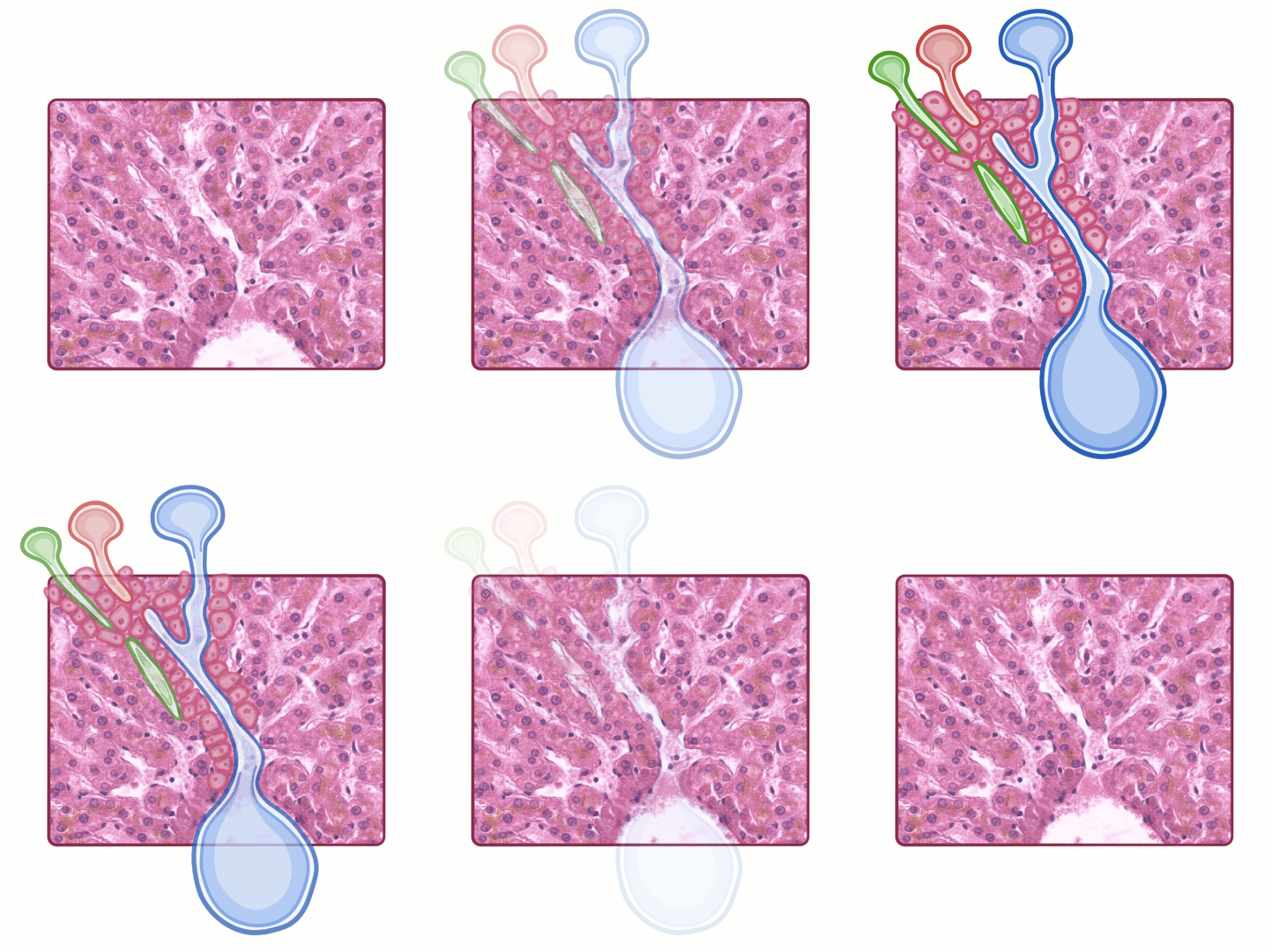
The histology image above is from the liver and an illustrated version of the liver's portal trial ducts are superimposed on the histology image to show where the ducts are actually located.
Visual cues for representing images in three-dimensional space
Some images represent a view from a three-dimensional plane or different angle than we're used to seeing things. In these cases, it can be helpful to give the viewer extra visual indicators as to what they are looking at by showing where the image is located in three-dimensional space.

The above histology image of the uterus would have been difficult to mentally visualize it's location without having the illustration to show what angle the image is coming from and also color-coordinated with the illustration for further explanation.
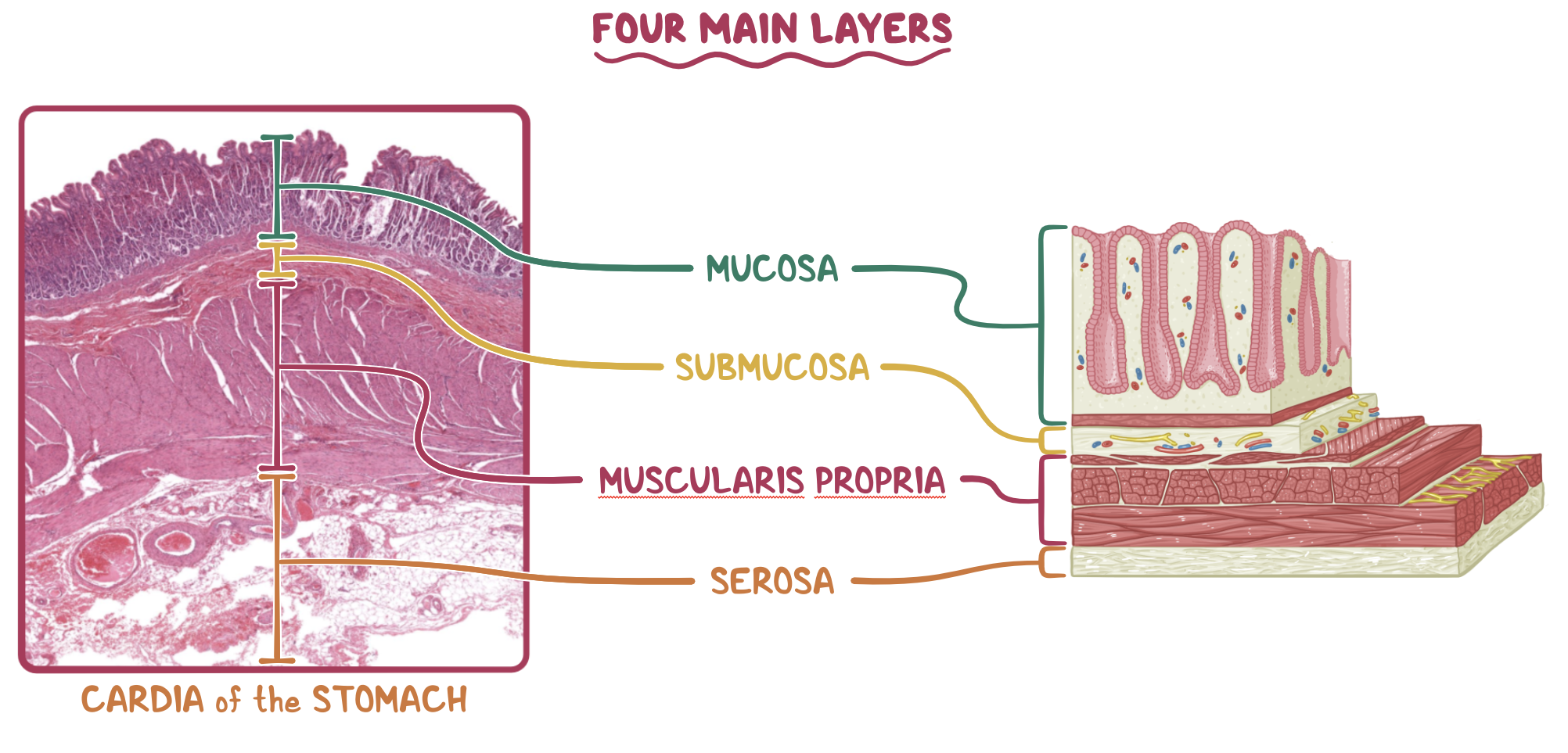
The above image is taken from the wall of the stomach. The different layers may be hard to visualize and separate without the proper labelling and also seeing an illustrated representation of the different layers in a semi-3d illustration.